How Long Does It Take to Learn German?

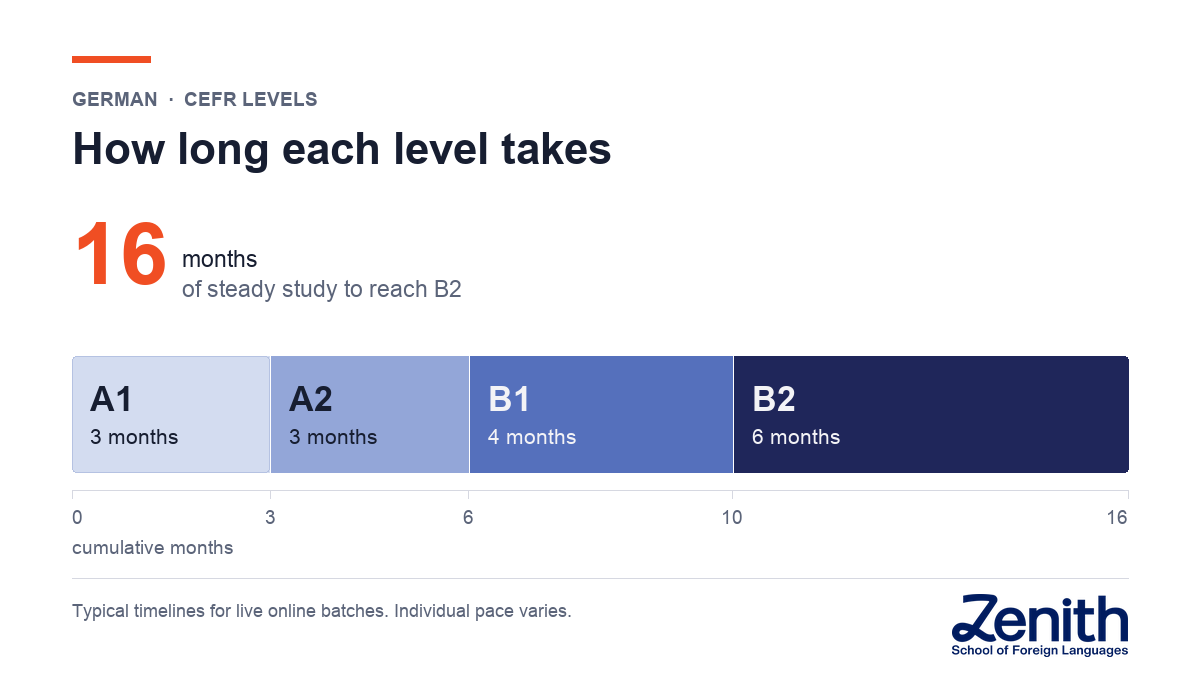
Learning German to B2 takes about 16 months of steady study: roughly 3 months for A1, 3 months for A2, 4 months for B1 and 6 months for B2. Those are the timelines Zenith School of Foreign Languages plans its batches around, and B2.2 is the level most employers ask for.
Reaching B1 takes about 10 months on the same schedule. German runs through six levels in all, A1 to C2, and you sit an exam at the end of each one.
That is the timeline. The harder question is which course actually gets you there, because the market is crowded with people promising the same thing in half the time. The rest of this guide covers what each level involves, how to choose between online group classes and one-to-one teaching, and what makes some students move faster than others.
How long each level takes
These are the timelines we plan our batches around at Zenith School of Foreign Languages. German runs through six levels, A1 to C2, and you sit an exam at the end of each one.
- A1 — about 3 months
- A2 — about 3 months
- B1 — about 4 months
- B2 — about 6 months
The certificates work the way school did. You studied the grade 6 syllabus, you were tested on grade 6, and your score decided whether you moved up. A Goethe-Zertifikat is issued the same way: you get it when you clear the exam for that level, and the score shows how well you understood it.
If you do not finish a level in three months, it is not the end of the world. Plenty of things slow a student down, and some of them sit on the teacher’s side of the screen, not yours. Language learning has become a box to tick for a job. Take the time you need.
Be careful with six-month fluency promises
Plenty of organisations will tell you they can take you from zero to fluent in five or six months. We do not believe that is possible. Most of us spend our entire lives learning English, which is not a natural language for Indians, and we are still correcting ourselves in our thirties. Treat a six-month fluency promise as a reason to ask harder questions, not as a selling point.
Online or classroom: what actually changes
Online classes save the hours you would lose on the road, and they let a school run without paying for a building. That is why most language training has moved online, and why German coaching in India now runs almost entirely over video. But the format suits some students and quietly defeats others, so it is worth knowing which one you are before you pay.
What online does well
- You can join from anywhere. You need a device and a connection, nothing else.
- More batches, more timings. We teach students across several time zones, and more trainers means more slots that fit around work.
- Recordings. Miss a session and you can watch it back, then walk into the next class knowing what happened in the last one.
- You can switch batches. If your timing stops working, or you are travelling, we move you.
Where online struggles
- Interest fades without someone watching. In a classroom there is the small fear of the teacher noticing you. Online, if you do not speak and do not turn your camera on, POOF, you are in class but you are not.
- Screens do not suit everyone. Some students need paper in their hands and a physical setup to concentrate. That is worth admitting before you enrol rather than three weeks in.
How we cover different time zones
Our students sit in different countries and different working hours, so we run trainers across different hours and days and offer combinations of batches to match. If your schedule is unusual, the fix is usually a different batch rather than a different format.
Group classes or one to one
We run both, and we are not neutral between them.
Group classes, capped at 15
A batch is a maximum of fifteen students at the same level, starting with introductions between the trainer and the group.
- More interaction, and more viewpoints on the same topic.
- A bit of competition, because everyone wants to be the strongest in the room.
- You meet people. A student living abroad with no one around them ends up in a batch with someone who lives nearby, and now they know one person in a new country.
- Batches fill and finish on schedule, so we can keep opening new ones.
One to one, which we rarely recommend
We suggest 1:1 only when a student cannot fit any batch timing and is genuinely uncomfortable in a group. Four reasons we steer people away from it:
- Almost no interaction. It is one trainer and one student, and real conversation practice needs more than that.
- It gets monotonous for both sides. Three months of looking at the same face, and you run out of things to talk about.
- It takes longer to finish, because a single student reschedules and cancels around their own life. In a batch, nobody waits for anyone.
- Progress is slower.
What affects how fast you learn
- Why you are studying. Three months is enough to clear an exam either way, but how much you keep depends on what you came for. Students who start out wanting to learn the language stay interested to the end. The ones studying only to pass struggle, and we see it often.
- What you do outside class. The trainer delivers the lesson plan, and that is their part. The hours you spend going back over it, pushing a little further than the homework, are what separate students.
- Starting early. Most Indian schools teach a foreign language, and most of us treat it as a subject to score in. Study it the way you later study to land a job and you would be halfway through the levels before you leave school. Almost nobody is told what these languages are actually worth.
How technology fits into the teaching
Recent tools have taken some of the load off lesson planning, but they do not replace the trainer. A generated plan still needs an experienced teacher to catch the mistakes in it and add what is missing.
Where it genuinely helps is listening and speaking practice. We use voice notes to work on fluency. Another trick: play audio from Google Translate without sharing your screen, so students hear the line without seeing it and have to work out what was said. It trains the ear for accent and rhythm in a way reading the same sentence never does.
What happens if you miss a class
We are asked this more than anything else. Every session at Zenith is recorded. Watch the recording, finish the work from it, then join the next class as though you were there.
Which kind of student are you?
Almost everyone who enrols falls into one of three groups, and each has a different route in.
- Complete beginners working towards a specific exam, usually the Goethe exam. The simplest case: pick a batch that suits your schedule and start.
- Returners who studied some German at school or college and want to pick it back up for their career. We test you first and recommend a level and a batch based on the score.
- Students coming back after dropping off. This group has the highest absenteeism, then returns wanting to join a later batch. We move them across quickly.
How to enrol
- Beginners: state your level, choose your batch, pay, start learning.
- Returners: take the assessment test, get your score, choose a batch, pay, start learning.
- Coming back: show your previous payment, tell us what happened, choose the next batch, pay if there is anything to pay, start learning.
You can see every live batch, its schedule and its fee on our German course page, and the same for French and English and IELTS. If you are not sure where you sit, take the free level test first.
What you get once you are in
You are added to a WhatsApp group with your trainer, where the study material and class links are shared. The trainers walk you through the process from there. There are no hidden costs beyond what you pay at enrolment.
If you are weighing up German for work rather than for an exam, we have written separately about the roadmap from India to a job in Germany and the careers German actually opens.